
A Practical Introduction to Spec-Driven Development
Spec-Driven Development isn't new, but AI has exposed something many teams already knew: good implementations usually start with clear requirements. Here's why specifications, constraints, and acceptance criteria matter more than ever.
Over the last year, I've noticed a strange shift in my day-to-day work.
I'm still shipping software, reviewing pull requests, and solving production problems. But I'm spending less time writing code and more time defining what should be built in the first place.
The more AI becomes part of the development workflow, the more I've realized that implementation quality often depends on something much earlier than code.
What Is Spec-Driven Development?
Before going further, it's worth defining what Spec-Driven Development actually means.
At its core, it's the practice of defining what should be built before focusing on how it will be implemented. The specification becomes the source of truth, describing goals, requirements, constraints, and success criteria clearly enough to guide implementation.
This isn't a new idea. Teams have relied on requirements, design docs, and technical specifications for decades because vague requirements usually lead to vague implementations.
What AI has changed is how quickly those gaps become visible.
Experienced developers often compensate for missing information by asking questions and identifying edge cases. AI tends to make those assumptions immediately and keep going.
As a result, the quality of the implementation becomes much more dependent on the quality of the specification. AI hasn't invented Spec-Driven Development, but it has made its value much harder to ignore.
Prompt Versus Specification
Something I've seen quite a bit lately is people treating prompts and specifications as the same thing. They're related, but they're definitely not the same.
For example:
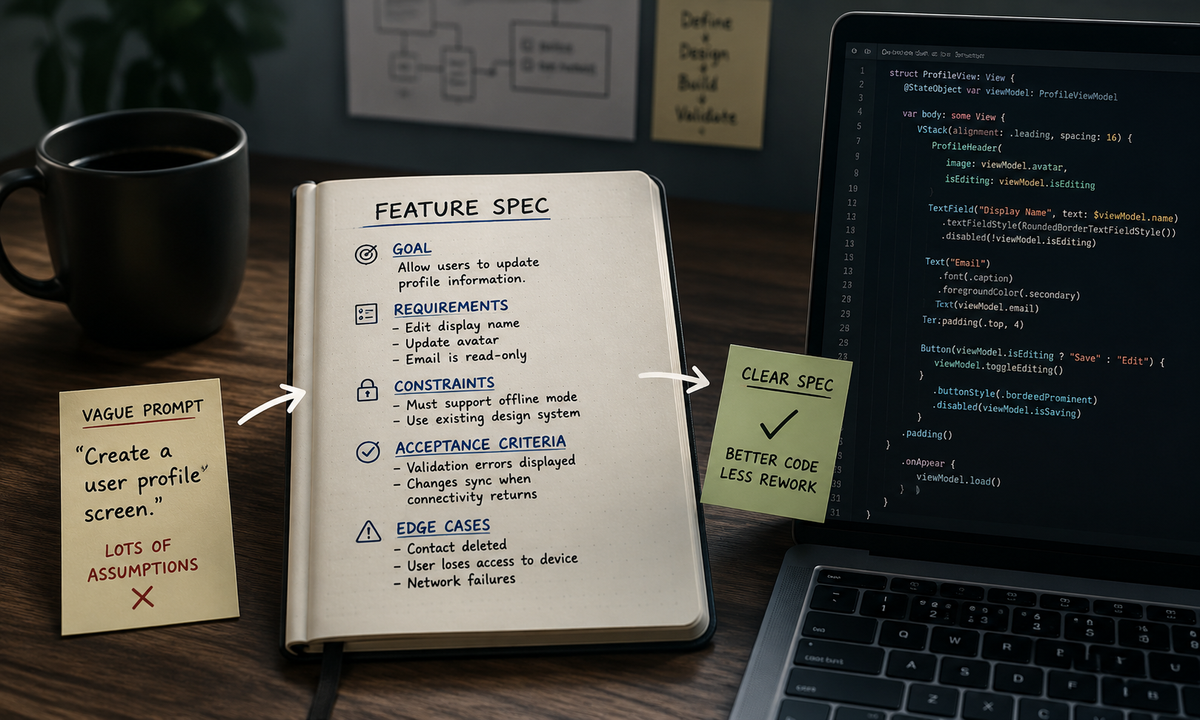
Create a user profile screen.Most AI tools will happily generate something from that. You'll probably get a form, some inputs, a save button, maybe avatar uploads, validation, and a few other nice touches.
The problem is that every one of those decisions required assumptions. Should email be editable? Should profile updates work offline? What validation rules exist? Should it use the company's design system? Does changing profile information require re-authentication?
None of that exists in the original request. The AI still has to make a decision, so it invents one.
Now compare that with something like this:
Goal:
Allow users to update profile information.

Requirements:
- Edit display name
- Update avatar
- Email remains read-only

Constraints:
- Must support offline mode
- Must use existing design system

Acceptance Criteria:
- Validation errors displayed
- Changes synchronize when connectivity returns
Same tool. Same model. Same framework.
The difference is that the problem is much better defined.
Personally, I think a lot of what people call "prompt engineering" is really just writing clearer specifications. Once goals, constraints, and success criteria are explicit, both humans and AI tend to perform better because there's less room for interpretation.
Who Reads Your Specs Now?
For years, documentation was mostly written for people. Product managers needed requirements, developers needed implementation details, QA needed acceptance criteria, and future team members needed context about why certain decisions were made.
Now there's another consumer of those documents: AI.
What's interesting is that the things that make documentation useful for humans also make it useful for AI. Clear goals, explicit constraints, defined success criteria, and documented edge cases help everyone involved understand the problem more accurately.
In different teams, I've seen this information captured in PRDs, RFCs, ADRs, Feature Specs, Jira tickets, design documents, and sometimes even well-written pull requests.
The format has never been the deciding factor. What consistently matters is whether the important decisions, constraints, and expectations are captured somewhere before implementation begins.
Honestly, I don't think the name matters much. What matters is whether the document removes ambiguity before implementation starts.
The more I work with AI-assisted development, the more I appreciate anything that forces clarity early. Not because AI requires it, but because unclear requirements were already a problem long before AI showed up.
AI didn't create the need for better specifications. It simply exposed how valuable they were all along.
Real Specifications Are Messy
One thing worth mentioning is that real-world specifications rarely look as clean as examples in blog posts.
In practice, requirements are often scattered across Slack threads, Jira tickets, Figma comments, meeting notes, and tribal knowledge that lives inside people's heads.
I've found that a large part of Spec-Driven Development isn't writing perfect documents. It's collecting fragmented information and turning it into a shared understanding before implementation starts.
AI has made that process more visible because every missing detail eventually turns into an assumption.
What AI Has Exposed
One lesson that surprised me is how often implementation issues start long before implementation itself.
When AI generates something unexpected, it's easy to blame the tool. But I've found that many failures come from missing information rather than poor code generation: unclear requirements, undocumented constraints, or unstated assumptions.
Over time, the same patterns keep appearing: ambiguous requirements lead to ambiguous implementations, missing constraints become assumptions, edge cases rarely appear unless explicitly mentioned, and clear acceptance criteria reduce rework.
None of this is new. Most experienced engineers already know it.
What changed is that AI exposes these weaknesses immediately. A human developer might compensate through experience, intuition, or conversation. AI usually can't (at least for now). If something is missing, you'll often see the consequences within seconds.
That's why I've started treating AI as a feedback mechanism for requirement quality. When the generated solution consistently misses the target, there's a good chance the problem statement needs work.
Final Thoughts
There's a common concern that AI will make engineering judgment less important.
So far, my experience has been the opposite.
As implementation becomes easier, understanding the problem becomes more valuable. Generating code is getting cheaper, but defining the right thing to build is still hard.
The engineers who consistently get good results aren't necessarily the ones writing the most code. They're usually the ones asking the right questions, identifying constraints early, thinking about edge cases, and making expectations explicit. Those skills mattered before AI and, if anything, they matter even more now.
For me, Spec-Driven Development isn't really about producing more documentation. It's about reducing ambiguity before implementation begins. Sometimes that means writing a detailed document. Sometimes a single page of notes is enough. The format isn't the important part; the clarity is.
The idea itself isn't new. What's new is how quickly AI exposes vague thinking.
And if there's one thing I've learned from working with AI-assisted development tools, it's this:
Good implementations usually start with good specifications.