The Difference Between Code Complete and Launch Ready
One lesson I've learned from production launches is that code complete and launch ready are not the same thing. A working app build is only one part of a successful release, and some of the biggest launch delays happen after development is finished.
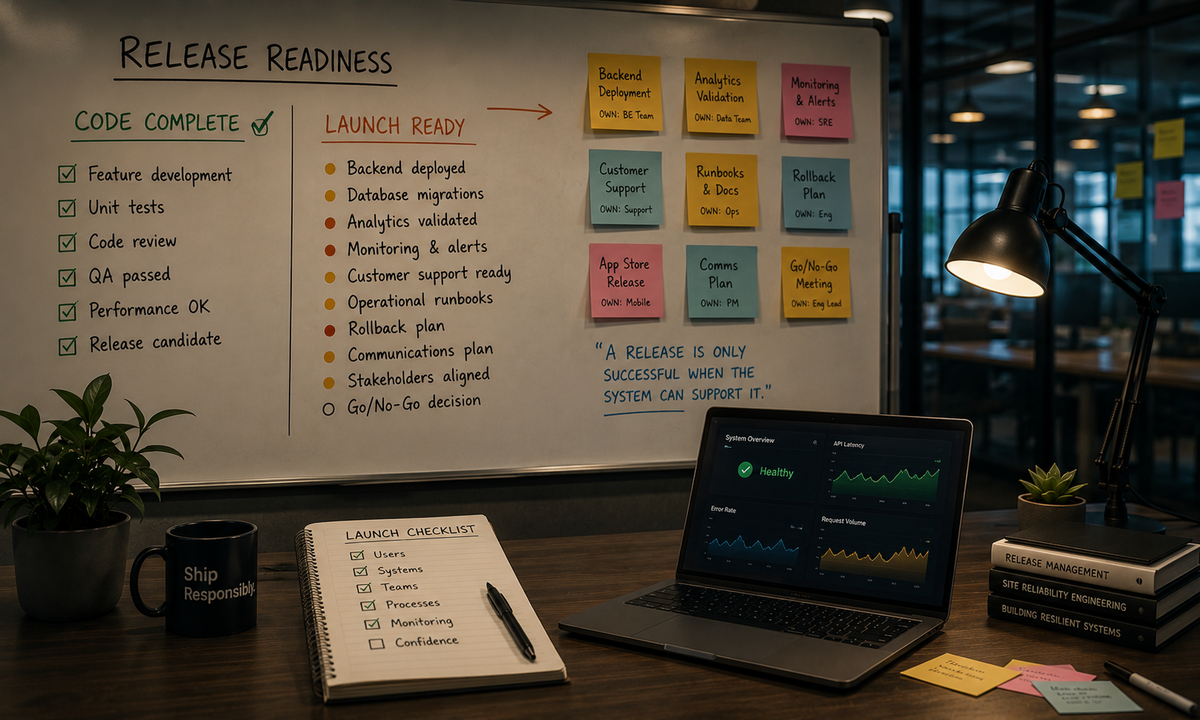
One lesson I've learned after participating in multiple production launches is that teams often confuse code complete with launch ready. They sound similar, but they're very different milestones: code complete means the feature has been built, while launch ready means the entire system is prepared to support it.
Early in my career, I thought that if the app was working, QA had signed off, and App Store approval was done, we were essentially finished. After enough launches, I realized that's rarely how it works.
I've been in situations where the mobile app was ready, QA had approved the release candidate, and the build was sitting in TestFlight waiting to go live, yet we still couldn't launch. The reason wasn't a crash, a bug, or missing functionality. The problem was that the broader system wasn't ready.
Sometimes a backend deployment was still pending. Other times, analytics events hadn't been validated, operational processes weren't defined, monitoring wasn't in place, or support teams hadn't been briefed on what was about to change. The code was finished. The launch wasn't.
Software Delivery Is a Coordination Problem
One thing that surprised me over time was how often these situations appeared across completely different companies and industries. I've seen versions of the same problem in startups, large organizations, consumer products, and highly regulated environments. The specifics change, but the pattern doesn't.
Many engineers think software delivery is primarily a technical challenge. In reality, successful releases are often coordination challenges disguised as technical ones. Every production launch depends on multiple teams, systems, processes, and decisions aligning at roughly the same time.
The mobile application and backend might be ready, but if customer support isn't prepared for incoming questions, users can still have a poor experience. The payment flow might work perfectly, but if nobody has defined how refunds, disputes, or operational incidents will be handled, you're still not truly ready. Likewise, a feature may perform exactly as expected, but without proper monitoring in production, you're still taking on risk.
This is one of those lessons that becomes increasingly obvious the more launches you participate in. Very few releases fail because a button is misaligned; many fail because the surrounding system wasn't prepared to support the change.
Code Complete vs. Launch Ready
One pattern I've noticed is that junior engineers often think about readiness in terms of code completion, while senior engineers tend to think about readiness in terms of system readiness.
Those are very different things.
A feature is complete when the implementation is finished. A launch is complete when the organization is ready to support it.
That distinction completely changed how I approach release planning.
Today, when I participate in launch discussions, I spend less time asking:
Is the app ready?
And more time asking questions like:
- Is the backend deployed?
- Are analytics validated?
- Do support teams know what is changing?
- Is monitoring in place?
- Do we have rollback plans?
- Have we tested production-like scenarios?
- Who is on call if something goes wrong?
None of those questions require writing more code, yet they often determine whether a launch succeeds or fails.
The Bigger Picture
The longer I work in software, the more I believe engineering is not just about building systems. It's also about helping organizations safely change systems.
That challenge extends far beyond shipping an app. In many cases, the application itself is ready long before the surrounding processes, teams, and dependencies are prepared to support it.
And that's why some launches are delayed even when development is finished: the app may be ready, but the system isn't.