The Principles Everyone Quotes… and the Trade-offs Real Engineers Actually Make
One thing I’ve learned working on production systems over the years is that good engineering is rarely about following principles perfectly.
Because real-world development constantly puts principles in conflict with each other.
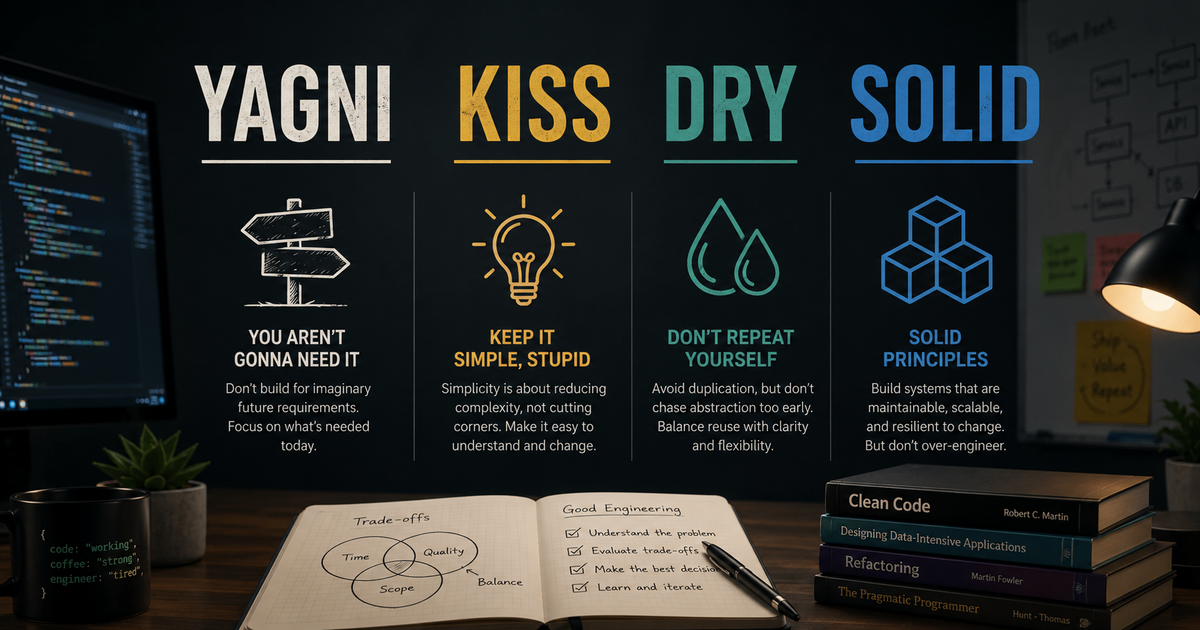
YAGNI. KISS. DRY. SOLID.
They all make sense individually. Until deadlines, legacy systems, unstable requirements, production pressure, and business realities enter the picture.
Early in your career, these principles feel almost absolute. You try hard to apply them correctly because they genuinely improve code quality.
But production systems slowly teach you something else: Every engineering decision has a cost. Even the “correct” ones.
And that’s where engineering starts becoming less about rules… and more about judgment.
YAGNI
“You Aren’t Gonna Need It”
This principle exists for a good reason. It prevents engineers from building giant systems around imaginary future requirements.
And honestly, over-engineering is one of the easiest traps to fall into when you care about architecture, but real-world systems create an uncomfortable tension here. Because sometimes you do know something is coming.
You’ve seen the roadmap enough times. You recognize business patterns. You know certain flows will evolve sooner rather than later.
So the challenge becomes:
Where’s the line between good engineering foresight and unnecessary architecture?
Because yes, building massive abstractions “just in case” is usually a mistake, but pretending obvious future requirements don’t exist can also create expensive rewrites later.
The hard part is that both decisions can be defensible depending on the context.
KISS
“Keep It Simple, Stupid”
This one gets misunderstood constantly.
Simple does NOT always mean:
- Less code
- Fewer layers
- Quick hacks
- No structure
Sometimes the truly simple solution is actually the more structured one because future changes become easier and safer.
But under real release pressure, another conflict appears.
You may know the elegant solution. You may know the “clean” way.
But you also know:
- The release is already late
- The codebase is fragile
- QA time is limited
- Touching certain areas increases risk
So sometimes the smartest engineering decision becomes:
“Ship the isolated ugly fix safely.”
Not because it’s beautiful. Because it minimizes blast radius. And honestly, experienced engineers know this feeling very well.
DRY
“Don’t Repeat Yourself”
Probably one of the most over-applied principles in software engineering.
A lot of developers see duplicated code and immediately feel the urge to abstract it.
But in large production systems, that’s not always the best trade-off.
Sometimes:
- Requirements are still evolving
- The similarities are only partial
- The flows will diverge later anyway
- Understanding the existing abstractions is already expensive
And this happens a lot in mature codebases.
You know there’s probably something reusable somewhere. But auditing the entire system to find the “perfect reusable solution” may cost more time and introduce more risk than solving the feature directly.
Ironically, trying too hard to follow DRY often creates abstractions that become harder to maintain than the duplicated code itself.
Sometimes duplication is cheaper. Sometimes duplication is safer. Sometimes duplication is clearer.
That’s the uncomfortable part people rarely talk about.
SOLID
SOLID principles are incredibly useful, especially in large-scale systems.
Things like:
- Separation of concerns
- Dependency inversion
- Composition over inheritance
…absolutely improve maintainability over time, but this is another area where engineering reality pushes back, because architecture also has a maintenance cost.
I’ve seen tiny features end up with:
- Multiple protocols
- Factories
- Coordinators
- Abstraction layers everywhere
…for flows that never evolved again.
And suddenly the code becomes technically “clean,” but operationally harder to navigate.
That’s the tricky part:
Good architecture should reduce complexity, not just redistribute it.
The Real Lesson
The longer I work in production systems, the more I believe this:
Good engineers don’t blindly follow principles.
They understand:
- Why the principle exists
- What problem it solves
- What trade-off it introduces
- And what happens if they over-apply it
Because principles are supposed to support decision-making, not replace it, and just to be clear, I’m not saying these principles should be ignored, far from it.
When they fit the problem, they absolutely should be applied, because they genuinely lead to better systems and better engineering practices over time.
But real-world software development sometimes forces difficult decisions where principles collide with deadlines, risk, legacy constraints, or business realities.
And honestly, I think that’s one of the biggest shifts that happens as engineers gain experience. You stop looking for perfect rules, and start learning how to make better trade-offs without losing sight of why those principles mattered in the first place.