Not Every Decision Is Clean. Here’s How I Make Trade-offs Under Pressure
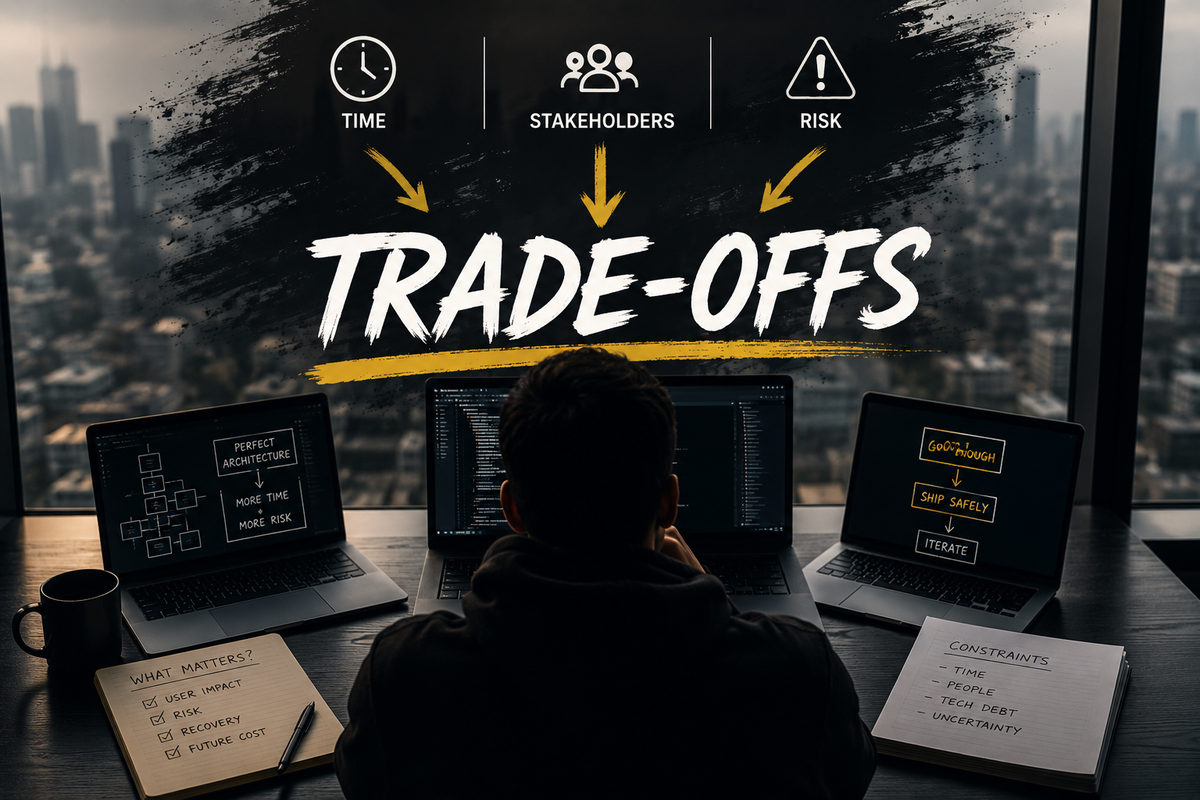
Most decisions are not clean.
You don’t always have time to design things properly. You don’t always get a stable backend. You don’t always get clear requirements.
And still... you’re expected to ship.
So the job is not to make perfect decisions. It’s to make good decisions with awareness of the trade-offs.
A situation I’ve run into more times than I’d like
You’re close to releasing.
Backend is “mostly ready”, but not fully consistent. There are edge cases you know about. QA found issues, but nothing critical. Product wants it out this week.
Now you’re in that uncomfortable spot where technically... you could delay. But realistically, the pressure is to move forward.
That’s where experience kicks in.
How I actually approach these decisions
This isn’t something I write down anywhere, but over time I noticed I always go through the same mental process.
1. What’s the real risk here?
Not theoretical risk, real impact.
- Can this break user trust?
- Can this affect money, auth, or data integrity?
- Or is it just a UI inconsistency?
There’s a huge difference between:
“this could break in an edge case”
and
“this could hurt users in a meaningful way”
Only the second one should really stop things.
2. Can I recover from this if it goes wrong?
This is one of the biggest decision drivers for me.
If I can:
- Patch it quickly
- Hide it behind a flag
- Roll back safely
I’m much more comfortable shipping.
If it’s something like:
- Bad data being written
- Schema issues
- Security concerns
Then I slow things down, no matter the pressure.
3. Am I creating future problems for the team?
This is where I’ve seen things go wrong a lot.
Sometimes we “move fast” but leave behind:
- Code nobody understands
- Hacks that spread
- Fragile flows that keep breaking
I try to ask myself:
“Is this saving time... or just postponing a bigger problem?”
If it’s the second one, I rethink it.
4. Can I contain the mess?
I’m okay with imperfect solutions.
I’m not okay with messy solutions that spread.
If I need to hack something, I try to:
- Isolate it
- Keep it localized
- Avoid leaking it into the rest of the architecture
Temporary solutions become permanent way too often.
So at least I try to keep the damage controlled.
A real example from a fintech project
In a fintech company I worked at, I ran into one of these situations during a release cycle.
We had a release window coming up tied to a security-related flow, and multiple teams were involved. Backend changes were still evolving pretty late in the process.
From a technical perspective, it wasn’t clean:
- Some responses weren’t fully consistent
- Edge cases existed
- Parts of the flow still needed polish
At that point the question wasn’t:
“Is this well designed?”
It was:
“Is this safe enough to ship?”
So the decision came down to a few things:
- Making sure anything related to auth and user safety was solid
- Isolating the unstable parts as much as possible
- Being very explicit with the team about what we were accepting
We moved forward with the release.
Not because it was perfect, but because the risk was understood and controlled. And just as important, we already knew what needed to be fixed next. That experience shaped how I think about trade-offs.
It’s not about avoiding imperfect decisions, it’s about making them responsibly.
What this actually looks like in practice
I’ve shipped features where:
- Backend contracts weren’t ideal
- UI had rough edges
- Flows weren’t fully optimized
But:
- Core functionality was solid
- Risk was understood
- Fixes were already planned
The difference is that the decision was intentional, not just “let’s hope nothing breaks”.
The part that matters more than people think
These decisions are not just technical. They’re about communication.
If I decide to move forward with trade-offs, I make sure:
- Product understands what we’re accepting
- The team knows where the risks are
- There’s a clear follow-up
Because the worst outcome is not a messy decision. It’s a messy decision that nobody owns.
What I’ve learned over time
Clean architecture is great. Best practices matter. But real-world engineering is messy. And your value as a senior engineer is not just writing clean code.
It’s being able to navigate messy situations without making things worse.
If I had to summarize how I think about it:
I don’t aim for perfect decisions. I aim for decisions I can explain and stand behind later.