The Bottleneck Is No Longer Writing Code
A few years ago, writing code itself was one of the main bottlenecks in software development.
Implementation took time.
Boilerplate took time.
Research took time.
Even translating ideas into working code was expensive.
Today, that’s changed.
Generating code is easier than ever.
You can scaffold features in minutes, generate networking layers, create tests, refactor code, build UI faster, and even get surprisingly decent architectural suggestions.
But after using AI heavily in real projects, I think something important is becoming very clear:
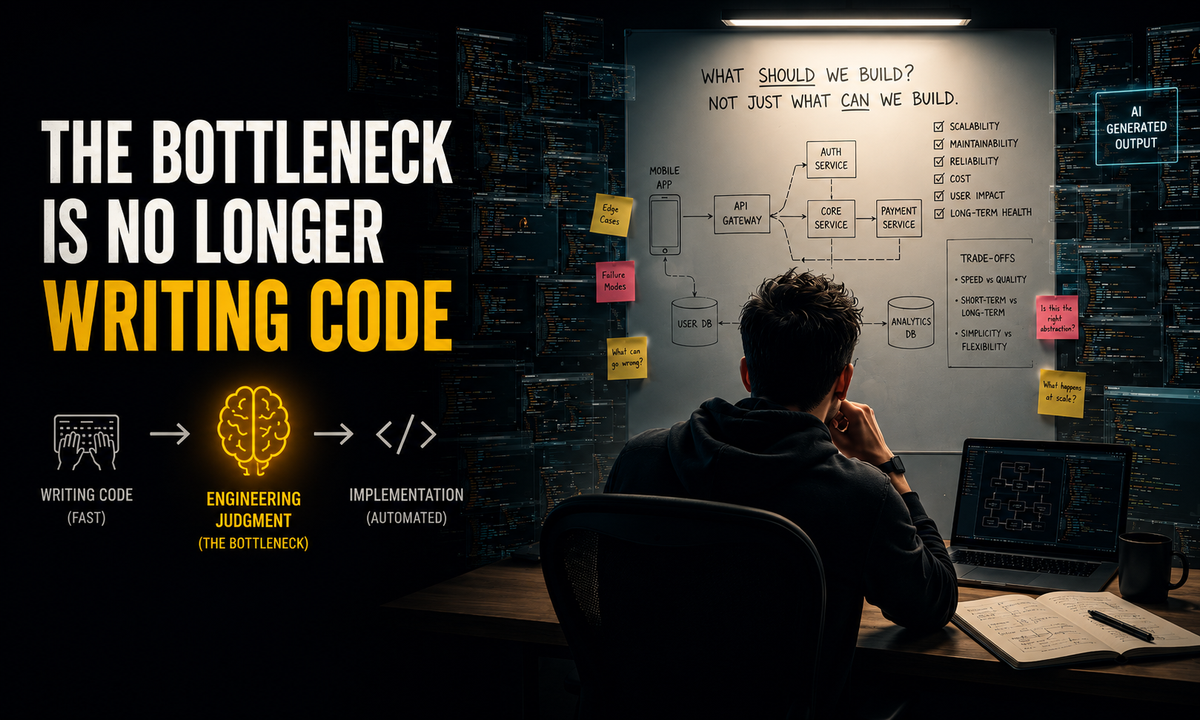
The bottleneck is no longer writing code.
It’s knowing what code should exist in the first place.Before AI, strong engineers were already valuable because they could:
- Understand consequences
- Spot edge cases
- Make trade-offs
- Prevent long-term problems
- Review architecture critically
- Understand system behavior under pressure
AI didn’t remove that. It amplified it.
Because now:
- Code generation is cheaper
- Implementation is faster
- Output is abundant
- Iteration cycles are shorter
- Shipping is easier than ever
So naturally, the bottleneck shifts, not toward typing faster, toward judgment.
The New Bottleneck
I’ve noticed something interesting while working with AI tools daily.
The biggest difference between engineers is no longer: “Who can write code faster?”
It’s:
- Who can validate correctly
- Who can detect subtle problems
- Who understands architecture deeply
- Who recognizes dangerous abstractions
- Who understands maintainability
- Who can separate “works” from “scales”
- Who knows when not to use AI-generated code
Because AI is very good at producing plausible code and honestly, that’s both the impressive part and the risky part.
Sometimes the generated solution looks clean, compiles perfectly, and even passes tests.
But if you trust it blindly, it can still introduce things like:
- Tight coupling
- Hidden performance issues
- Incorrect assumptions
- Race conditions
- Fragile abstractions
- Security risks
- Long-term maintenance pain
Not because AI is “bad”, but because large systems are nuanced.
A solution can look correct while still creating problems that only appear later under scale, edge cases, or real production usage.
I think that’s the part many people underestimate. AI dramatically speeds up implementation, but it doesn’t replace engineering judgment.
And that’s the part many people underestimate.
The Engineers Becoming More Valuable
Ironically, I think AI is increasing the value of experienced engineers. Not because seniors type faster, but because they usually have stronger filters.
They’ve seen systems fail.
They’ve dealt with production incidents.
They understand trade-offs.
They know that “clean” code isn’t always safe code.
They know architecture decisions have consequences months later, not just today.
The hard part is no longer generating 500 lines of code.
The hard part is deciding:
- Is this the right abstraction?
- Is this maintainable?
- What happens at scale?
- What breaks in production?
- What are the side effects?
- What’s the operational cost of this decision?
- What happens six months from now?
That’s engineering and AI didn’t remove it if anything, it exposed how important it always was.
AI Is a Multiplier
I don’t see AI replacing engineers. I see it amplifying them.
Strong engineers become dramatically faster, but weak engineering decisions also scale faster. That’s the real trade-off.
The companies that win won’t necessarily be the ones generating the most code. They’ll be the ones making the best decisions while generating it and honestly, I think this changes how we should think about engineering growth moving forward.
Learning syntax matters less than before. Understanding systems matters more.